A paddler propelling a blue kayak across calm open water, paddle mid-stroke, on a bright clear day

Air Horns for Kayaking & Paddling Safety

A 150 dB air-horn blast that runs off your cordless-drill battery — a loud, dependable sound signal for kayaks, canoes and SUPs out on open water.

49 products
150 dB output
2,000 ft remote
Pre-Built
Ships same day
90-day money-back
1-Year Warranty
How do I choose the right horn for me?

Pick the horn that runs on a battery you already own.

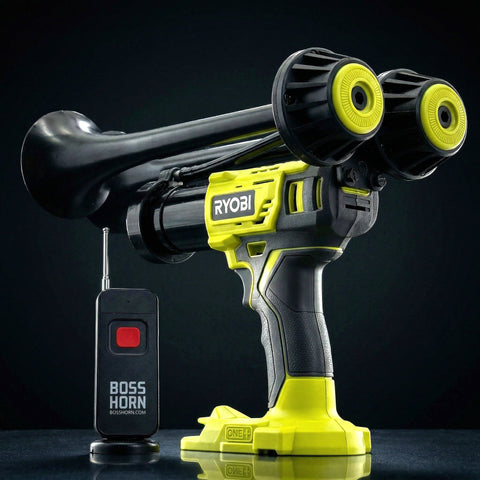
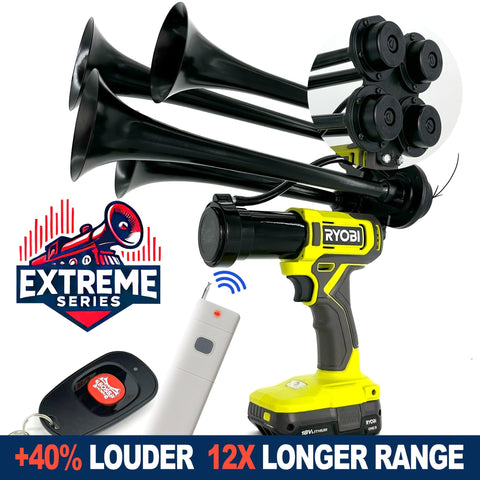
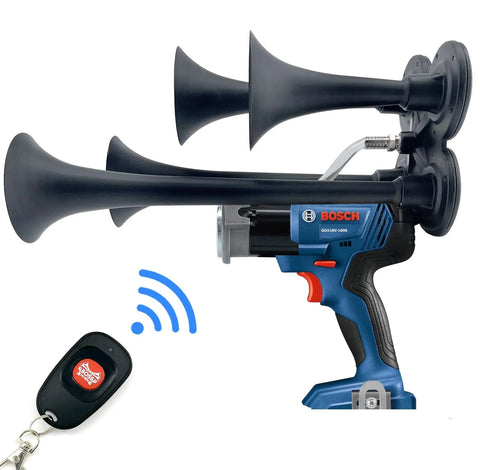
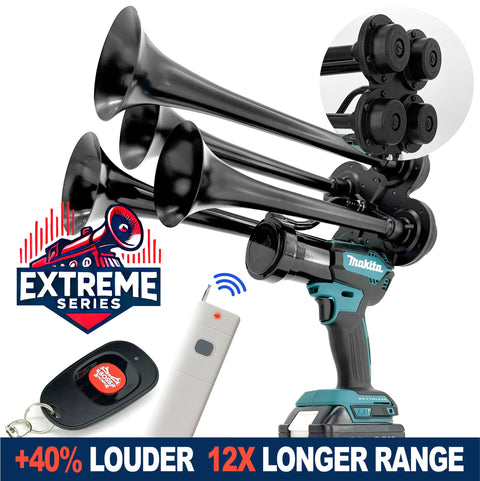
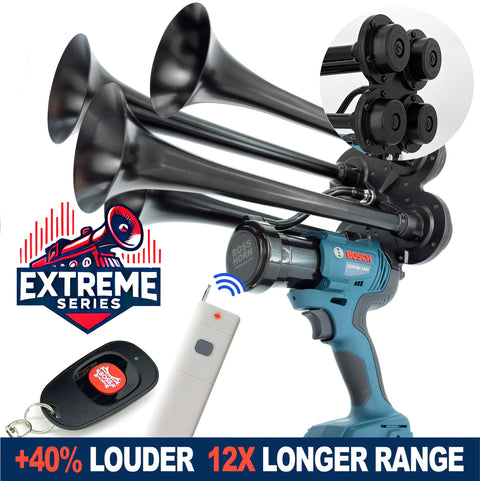
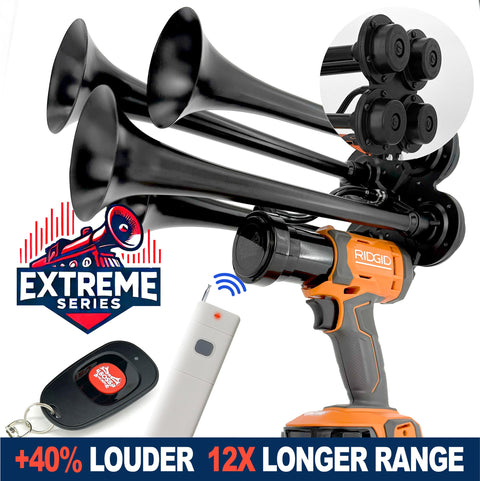
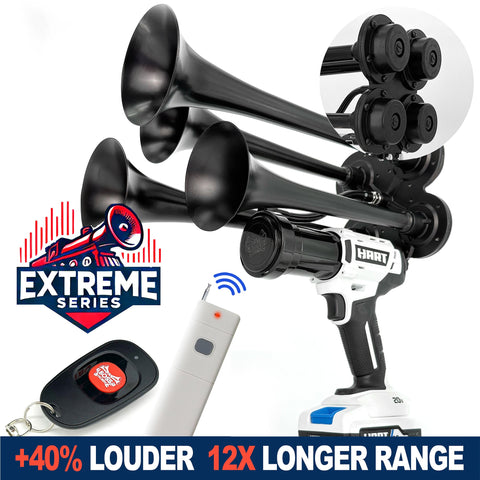
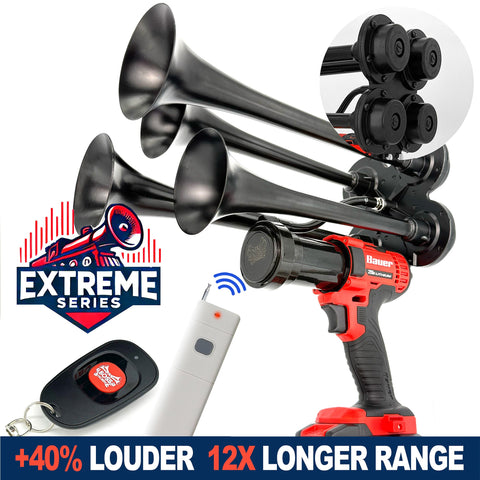
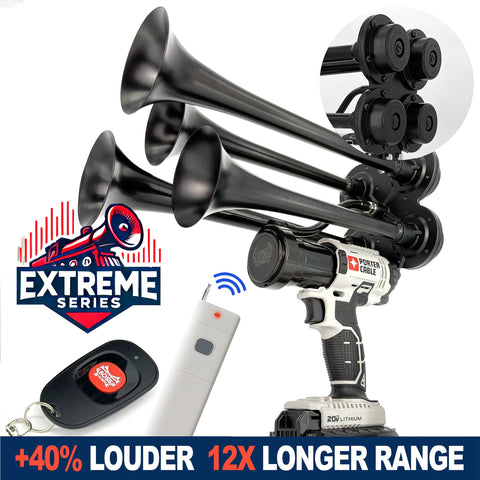
Runs on your existing tool batteries — the same packs as your drill or impact driver. No new batteries to buy or throw away: cheaper for you, easier on the planet.

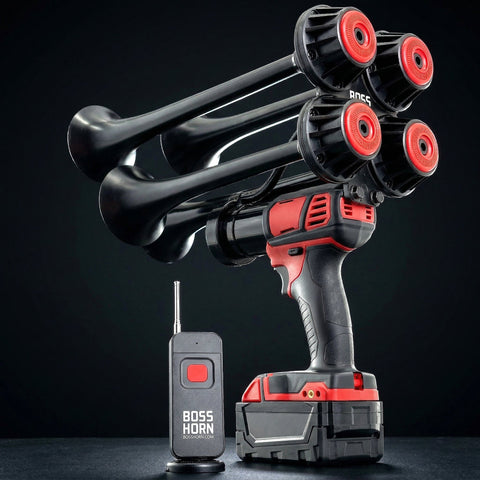
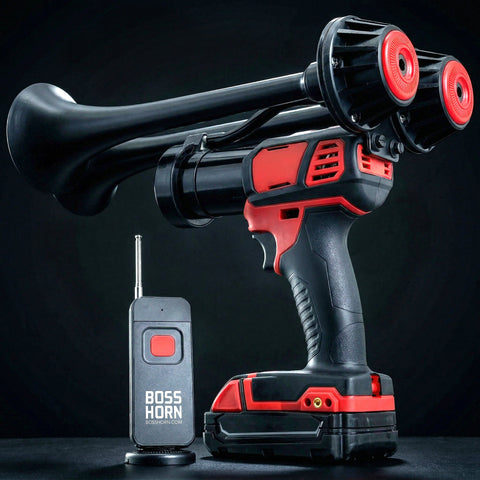
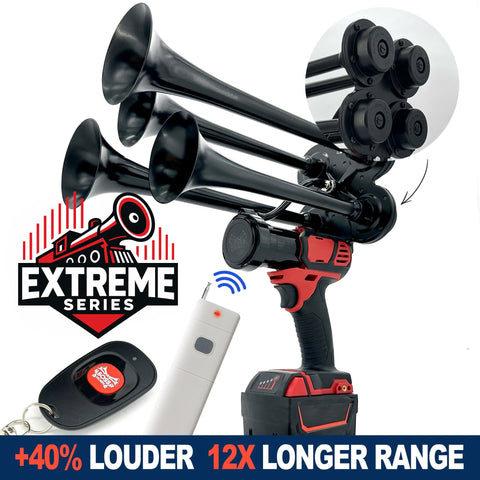
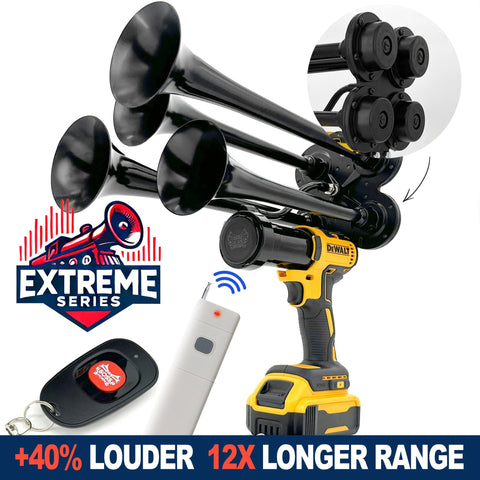
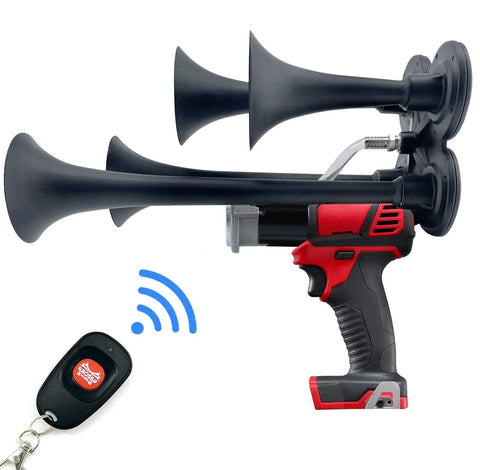
The brand changes nothing about the horn. Every horn uses the exact same internal and external parts — so a Quad is a Quad and a Dual is a Dual. They sound and perform identically across every battery brand; you give up zero sound or power.

No cordless tools yet? Go with DeWalt®, Milwaukee® or Ryobi® — they give you the widest range of tools to buy later on the very same batteries.

Which horn is the loudest?

Our loudest sit at the top — here's how the lineup ranks:

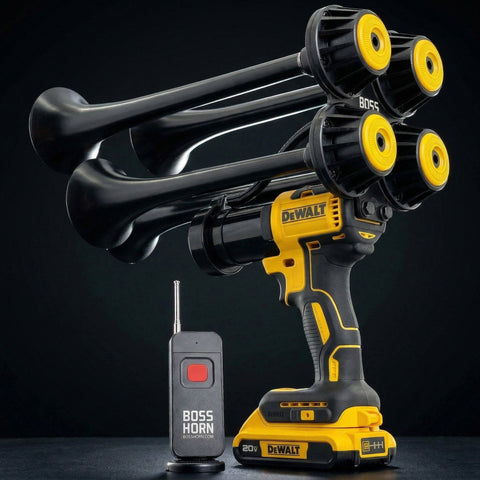
1. Boss Series — our newest (2026) and most refined; it reworks the older Extreme design and fixes its weak spots. Its older sibling, the Extreme Series, sits right alongside it.

2. Quad — four trumpets, big full sound.

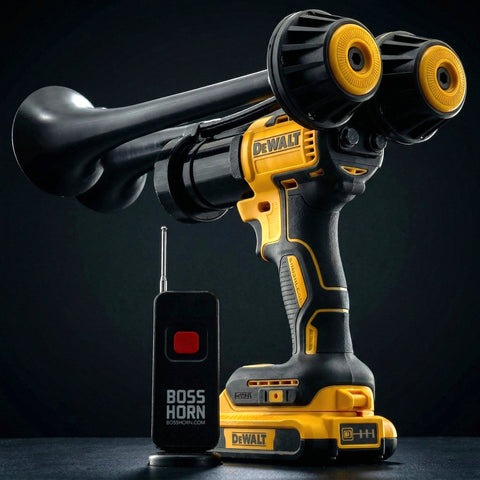
3. Dual — the 2026 Dual shares the Boss design, and it's the one to pick if your battery brand isn't covered by the Boss Series yet.

Skip the 5-trumpet. The on-board compressor can't push enough air for all five trumpets, so it ends up thinner and higher-pitched than it should.

Do I need a drill — or does it come with one?

No drill needed — and none included.

Ships fully built and ready to use — nothing to assemble, no tools required.

The only thing you add is a battery — the same cordless-tool pack your drill already uses.

Snap it in, pull the trigger — and it roars in seconds.

Boss Horn colour caps
Air Horns for Kayaking & Paddling Safety
Boss Horn
Boss Horn 1.51M subscribers
Subscribe

Why these horns own the waterline

  • 150 dB that carries across open water — a deep, low note that pushes past wind, chop and motor noise so a powerboat or a buddy two coves over actually hears you.
  • Wireless remote up to 2,000 ft — signal from the cockpit, the bow or back at the launch without fumbling for a fixed button.
  • Recharges off your drill battery — no pressurized canister to fizzle out mid-paddle and no cans to keep buying; top it up like any cordless tool.
  • Pre-built and grab-and-go — no compressor, no air tank, no wiring to rig; it's ready before you slide the hull into the water.
  • Deep freight-train tone — real metal trumpets give a low, urgent note that reads as a genuine distress or warning signal, not a toy squeak.

Train Horns Built for Kayaking & Paddling

Battery compatibility:
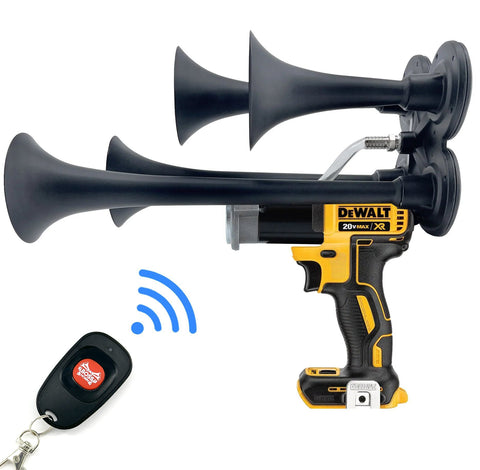
DeWalt Train Horn - Boss Series (New 2026 Model) - BossHorn - dark-14%
Loudness150 dB
Horn4 XL Trumpets
Heard up to1.5 miles
ToneDeep Low Pitch

Boss Series Train Horn for DeWalt® 20v Battery

$450.00 $385.00
5.0 (5)
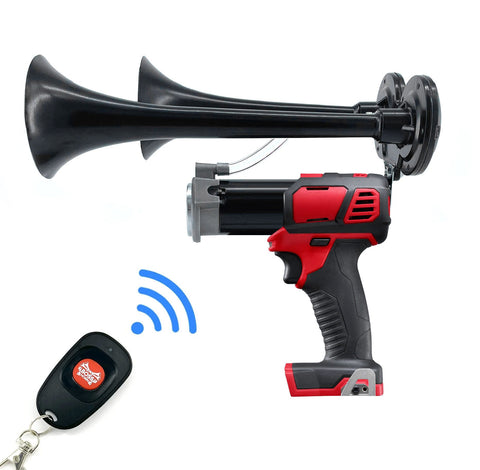
Boss Series Train Horn for Milwaukee® 18v Battery - BossHorn black-15%
Loudness150 dB
Horn4 XL Trumpets
Heard up to1.5 miles
ToneDeep Low Pitch

Boss Series Train Horn for Milwaukee® 18v Battery

$430.00 $365.00
4.7 (7)
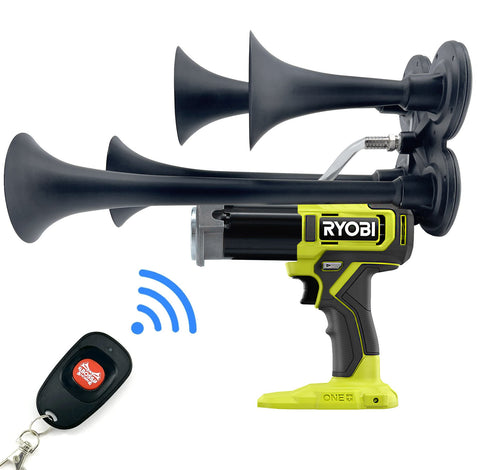
Ryobi Train Horn - Boss Series (New 2026 Model) - BossHorn dark
Loudness150 dB
Horn4 XL Trumpets
Heard up to1.5 miles
ToneDeep Low Pitch

Boss Series Train Horn for Ryobi® 18v Battery

$385.00
5.0 (3)
Dual Train Horn for Milwaukee® 18v Battery (New 2026 Model) - BossHorn black-27%
Loudness130 dB
Horn2 trumpets
Heard up to< 1 mile
ToneHigh pitch

Dual Train Horn for Milwaukee® 18v Battery (New 2026 Model)

$255.00 $185.00
5.0 (8)
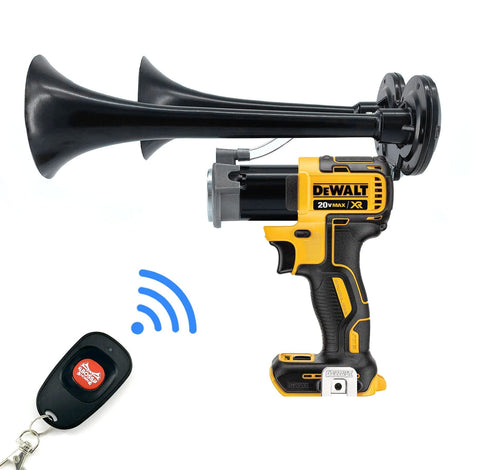
Dual Train Horn for DeWalt® 20v Battery (New 2026 Model) - BossHorn-25%
Loudness130 dB
Horn2 trumpets
Heard up to< 1 mile
ToneHigh pitch

Dual Train Horn for DeWalt® 20v Battery (New 2026 Model)

$280.00 $210.00
5.0 (6)
Dual Train Horn for Ryobi® 18v Battery (New 2026 Model) - BossHorn  dark-26%
Loudness130 dB
Horn2 trumpets
Heard up to< 1 mile
ToneHigh pitch

Dual Train Horn for Ryobi® 18v Battery (New 2026 Model)

$245.00 $180.00
4.8 (4)

Paddling air horns in action

Quick product demos of every horn — how it sounds, how it mounts on your drill battery, and how to use it as a sound signal on the water.

// Real owners

Straight from our customers

Real photos from real Boss Horn owners — tap any shot to zoom in.

Sound is safety on the water

Why an air horn belongs on every paddle

On a kayak, canoe or stand-up paddleboard you sit low and quiet — almost invisible to a powerboat bearing down at speed, and out of earshot of anyone on shore. A whistle helps, but a hard gust or an outboard motor swallows it fast. A real air horn gives you a sound signal with teeth.

These train-horn-style horns throw a deep 150 dB note that holds up against wind, wake and engine drone, and because the power comes from a cordless-drill battery, it's there for every launch — no fading canister to babysit. One blast says "I'm here, see me"; a string of them says you need help.

Are air horns allowed — or required — for kayaking?

Here's the honest answer paddlers like: on the water, a loud horn isn't just allowed, it's often required. U.S. Coast Guard navigation rules treat kayaks, canoes and SUPs as vessels, so each one must carry an efficient sound-producing device — a whistle or horn audible across open water. An air horn meets that kayak Coast Guard horn requirement and then some.

The catch is how you use it. A paddling sound signal is for safety — flagging your position to boat traffic, warning around a blind bend, or calling for help — not for blasting swimmers, anglers or wildlife. Keep it for genuine signaling, hold off in quiet no-wake coves and put-ins, and check your state's paddlecraft rules before you launch.

How loud do you need to be heard on the water?

Handheld air horns generally run between 110 and 150 decibels, and the kits in this collection reach up to 150 dB — a low, locomotive-grade blast meant to carry the roughly half-mile a marine signal needs to travel in open conditions, far past what a pea whistle manages into a headwind.

Use it responsibly. 150 dB is seriously loud, so aim the trumpets out over open water, never sound it near ears, kids, pets or a nearby paddler's head, and keep to short bursts. Loud is the whole point on the water — just point it at the horizon, not the cockpit next to you.

How a drill-battery paddling horn works

There's no compressor, no air tank and no wiring to splice. Each horn uses an on-board air pump and real metal trumpets, so the whole rig is self-contained and ready to grab off the shelf and drop in a dry bag.

Power comes from the cordless-drill battery you probably already keep in the garage. Slide it into the base — compatible with Milwaukee® M18™, DeWalt® 20V MAX, Makita® 18V LXT®, Ryobi® ONE+® and more — and pull the trigger. Select models add a remote that works from up to 2,000 ft, so you can sound a blast from the bow or from back at the launch. When the pack runs low, recharge it exactly like your drill — no cartridges to restock before a trip.

Choosing the right horn for the cockpit

Match the horn to how and where you paddle:

  • Trumpet count. Single, dual and quad-trumpet setups stack the tone — more trumpets mean a fuller, richer blast that carries.
  • Tone style. Pick a LOUDEST trumpet style for maximum reach across open water, or LOW TONE for that deep, serious freight-train growl.
  • Remote range. Remote models fire from up to 2,000 ft — handy from the bow, a raft-up or the put-in.
  • Battery brand. Choose the model that matches the drill batteries already in your kit, so you're never hunting for a pack at the ramp.
  • Grab-and-go. Everything ships pre-built, so it tucks into a deck bag or hatch with zero install.

Your pre-launch paddling safety check

Before you slide off the put-in, run the list:

  • Charged pack in the base — and a spare drill battery in your dry bag for a long day out.
  • Horn stowed dry and reachable — a deck bag, day hatch or cockpit cubby, not buried under gear you can't reach afloat.
  • Remote paired and tested if your model has one, so a blast is one press away.
  • Trumpets aimed outboard — point them over open water, away from your own face and any nearby paddler.
  • Know the signal and the rules — a long blast to mark your position, repeated blasts for distress, plus a quick check of local paddlecraft regulations before you go.

Kayaking & paddling air horns — FAQ

Are air horns allowed for kayaking, canoeing and paddleboarding?
Yes — and a sound-producing device is usually required, not just allowed. The U.S. Coast Guard treats kayaks, canoes and SUPs as vessels that must carry an efficient means of signaling. An air horn satisfies that requirement. Use it for genuine signaling — marking your position, warning boat traffic, calling for help — not to startle swimmers, anglers or wildlife, and check your state's paddlecraft rules before you launch.
How loud are these air horns?
They run up to 150 dB — a deep, locomotive-grade blast meant to carry roughly half a mile across open water, far past a pea whistle into a headwind. Because 150 dB is genuinely loud, aim the trumpets outboard over the water, keep to short bursts, and never sound it near ears, kids, pets or a nearby paddler.
Does it need a compressor or an air tank?
No. There's no compressor, no air tank and no canister to run dry. Each horn uses an on-board air pump and real metal trumpets powered by a cordless-drill battery, so the whole unit is self-contained and ready to drop in a dry bag or hatch.
Which drill batteries does it work with?
It's compatible with the major cordless-drill platforms — Milwaukee® M18™, DeWalt® 20V MAX, Makita® 18V LXT®, Ryobi® ONE+® and more. Pick the model that matches the batteries you already own so you're never short of power at the ramp.
How far does the remote reach?
Select models include a wireless remote that works from up to 2,000 ft, so you can sound the horn from the bow, from a raft-up of boats, or from back at the launch without reaching for a fixed button.
Can I use it as my Coast Guard sound signal on a kayak?
Yes. Coast Guard navigation rules require paddlecraft to carry an efficient sound-producing device, and a loud air horn meets that. Many paddlers carry it alongside a whistle on their PFD — the whistle is always on you, and the air horn gives you a far louder backup when a powerboat or a distant rescuer needs to hear you.
Is 150 dB safe to use on the water?
It's safe when you use it responsibly. 150 dB is loud enough to cause hearing discomfort up close, so point the trumpets outboard over open water, keep your own head and any nearby paddler clear of the blast path, and use short bursts rather than holding it down. Treat it as a safety signal, not a noisemaker.
How do I recharge it?
Recharge it exactly like your drill — pop the cordless-drill battery onto its charger and slide it back into the horn's base when it's topped up. There are no cartridges or compressed-air cans to buy or restock before a trip.
How fast does it ship?
Orders placed before 2 PM PT ship the same business day, so your horn is ready well before your next paddle.

About Air Horns for Kayaking & Paddling Safety

On a kayak, canoe or paddleboard, your voice doesn't carry — but a 150 dB blast does. These train-horn-style air horns give paddlers a serious sound signal that cuts across open water, powered by the same cordless-drill battery you already own. No tiny canister to run dry, no compressor, no tank. Grab-and-go safety gear for the launch, the lake and the long crossing.